
Ethereum gas fees: work used × price per unit

Share this article
Select & copy this link with your device’s copy command.
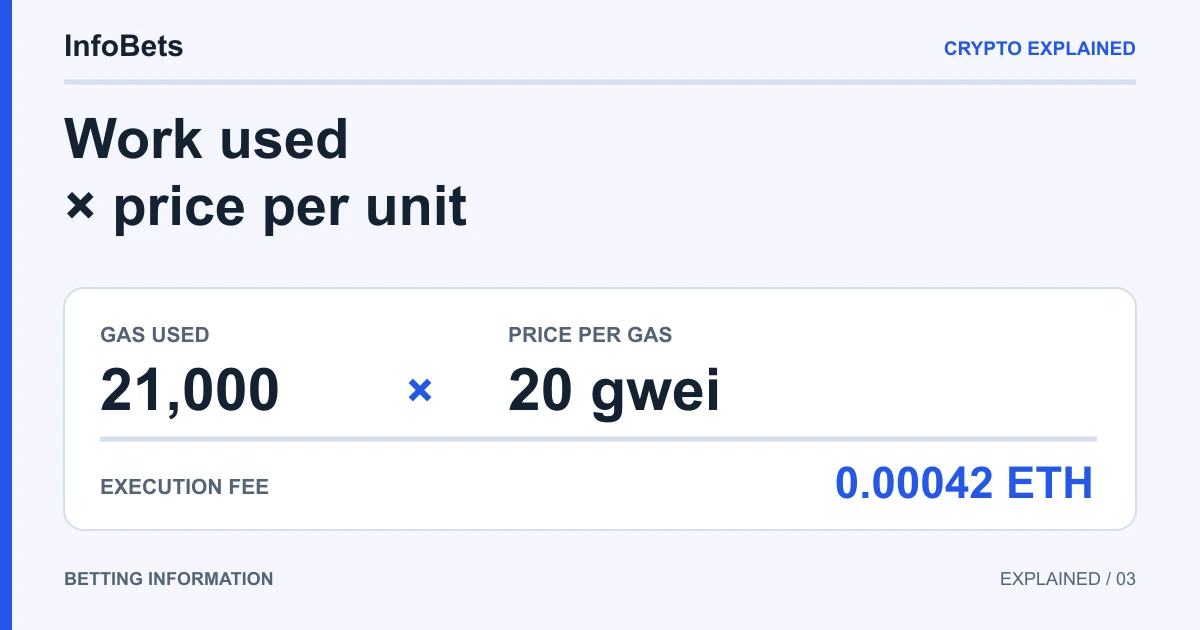
An Ethereum network fee pays for work carried out by the network. It is separate from the value transferred. Moving a larger amount does not, by itself, multiply the computational work by the same amount.
The useful distinction is how much work was used versus the price of each unit of work.
Gas is a unit, rather than another coin
Ethereum calls its unit of computational work “gas”. For an ordinary transaction using the current fee mechanism, the execution fee is gas used multiplied by the effective price per gas. That price comprises a base fee plus a priority fee. Fees are paid in ETH. Ethereum’s gas guide explains the units.
The base fee responds to demand under the protocol’s rules. It is burned, meaning removed from circulation. The priority component rewards the block proposer. The EIP-1559 specification describes the mechanism, including fee caps.
A worked example
Assume a fictional execution uses 21,000 gas. Its effective price is 20 gwei per gas: 18 gwei base fee plus 2 gwei priority fee. One gwei is one billionth of an ETH.
21,000 × 20 = 420,000 gwei = 0.00042 ETH.
That is the execution fee in this example, whether the separately stated transfer value is 0.01 ETH or 0.05 ETH, provided the execution uses the same gas. The figures are arithmetic inputs, not a current fee quote.
Changing the action can change gas usage. A contract interaction may do more work than a simple transfer. The name of the asset alone does not tell you the execution cost.
A limit is not a receipt
A gas limit caps the units a transaction may consume. A fee cap limits the price the sender permits per unit. Neither should be read as the final amount actually charged.
For instance, a displayed allowance of 30,000 gas does not establish that 30,000 was used. The receipt’s actual gas usage & effective price are the relevant inputs for calculating the execution fee.
Why a failed execution can still cost gas
An included transaction can consume computation before its contract execution fails. Reverting its state changes does not undo the work already performed, so gas can still be charged. This differs from a transaction rejected before inclusion; “failed” needs context.
If a website shows an additional service fee, read its definition separately. A line labelled “fee” is not enough to establish that the entire amount is a blockchain execution charge.
This explanation covers Ethereum execution gas. Other networks, layer-two services & specialised transaction types can have additional fee components. Use the relevant network’s documentation before applying the same calculation elsewhere.
Sources checked 14 September 2026. All numerical inputs are illustrative. Information only. 18+.
Discussion
Ask a question, add useful context or share a source. Keep it relevant & respectful.
Comments are reviewed before publication.