
Provably fair games: what the check proves

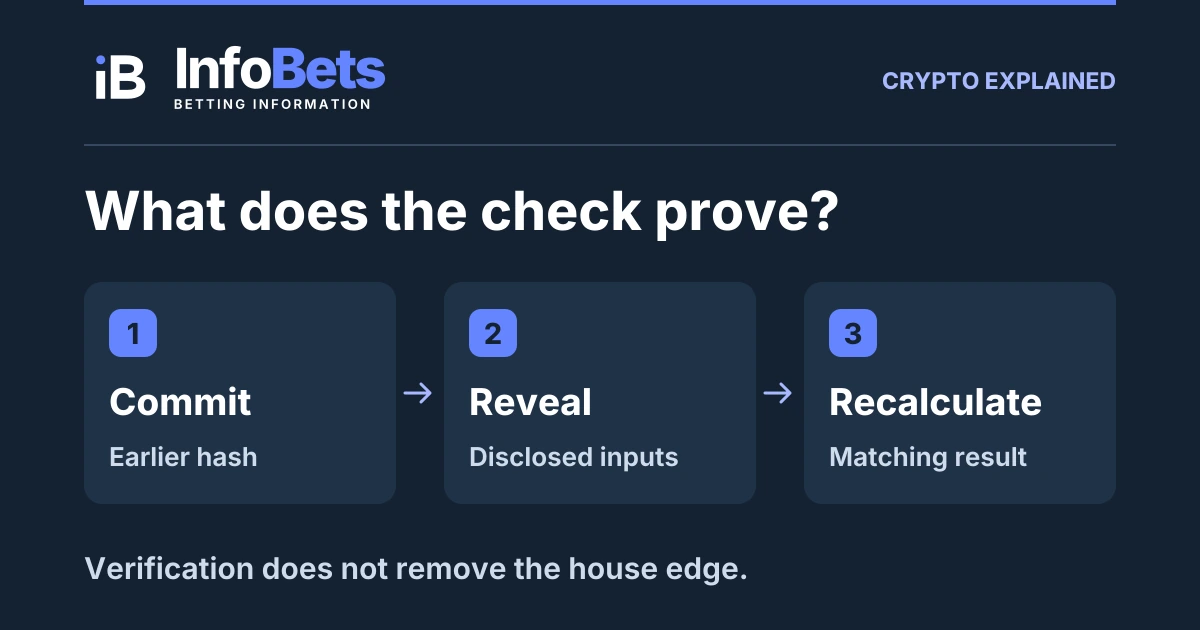
Provably fair verification lets you check whether a recorded game result matches a disclosed calculation & an earlier commitment. That check does not, by itself, establish favourable odds or guarantee that a business will pay withdrawals.
The details depend on the game’s documented implementation. A badge without the records & a reproducible method gives you little to examine.
Commit first, reveal later
One published example is BGaming’s workflow. It creates a result plus a secret value, then supplies a SHA-256 hash before the round. Think of that hash as a fingerprint of those inputs. A client seed also affects the final result, using a game-specific method.
After the round, the disclosed result & secret can be hashed again. The comparison checks the earlier commitment; applying the documented client-seed calculation checks the final result. This describes that supplier’s method, not every game labelled provably fair.
What a useful verification needs
- The earlier commitment: the value provided before the round, not merely a replacement shown afterwards.
- The complete inputs: the disclosed values required by that game’s method.
- The calculation: the exact rules for turning those inputs into the displayed result.
- The record: the round identifier, outcome & payout rules that applied.
Reproducing a result checks consistency with those records. It is not a substitute for examining randomness, the mapping to game outcomes or the payout table. Great Britain’s Gambling Commission technical standard addresses those matters separately.
A verifiable game can still have a house edge
Consider a fictional game with 100 equally likely results. You win on 49 of them. A winning €10 cash stake returns €20 in total, including the stake; a loss returns €0.
The theoretical average return is 49% × €20 + 51% × €0 = €9.80 per €10 staked. That is a 98% theoretical return to player, or a 2% house edge, before any fees or tax.
Every recorded result could match the verification method while that 2% edge remains. Actual results over a short session can differ sharply from the theoretical average.
Does a matching hash prove the whole site is safe?
No. The calculation does not inspect the company’s finances, withdrawal handling or legal permissions. It also does not predict your next result. Keep the game-verification question separate from the decision to trust a business. Information only. 18+.
Sources
- BGaming: its published verification workflow
- Gambling Commission: random outcomes & game rules
- Gambling Commission: theoretical & actual RTP
Sources checked 7 September 2026. Any numerical examples are illustrative.

Discussion
Ask a question, add useful context or share a source. Keep it relevant & respectful.
Comments are reviewed before publication.