
AI betting predictions: what does 70% mean?

An AI system’s “70% chance” is an estimate. To judge it, you need to know how it was produced & how similar predictions performed on data the system had not used to build its model.
A percentage written by a chatbot, a statistical model’s output & a probability calculated from betting odds can look identical. They answer different questions.
Ask where the number came from
A prediction model can use recorded inputs to estimate an outcome. A general-purpose language model generates a response to a prompt; a confident number in that response is not automatically a tested sports forecast. NIST documents how generative systems can present incorrect content confidently.
A chatbot may be connected to a separate forecasting model or live data. If so, the useful evidence is the named data, forecast time, method & evaluation behind that number.
Calibration: do the percentages match the results?
Calibration compares predicted probabilities with observed frequencies. Across many comparable predictions near 70%, a well-calibrated system should see the predicted outcome occur about 70% of the time. It does not promise exactly seven successes in the next ten events.
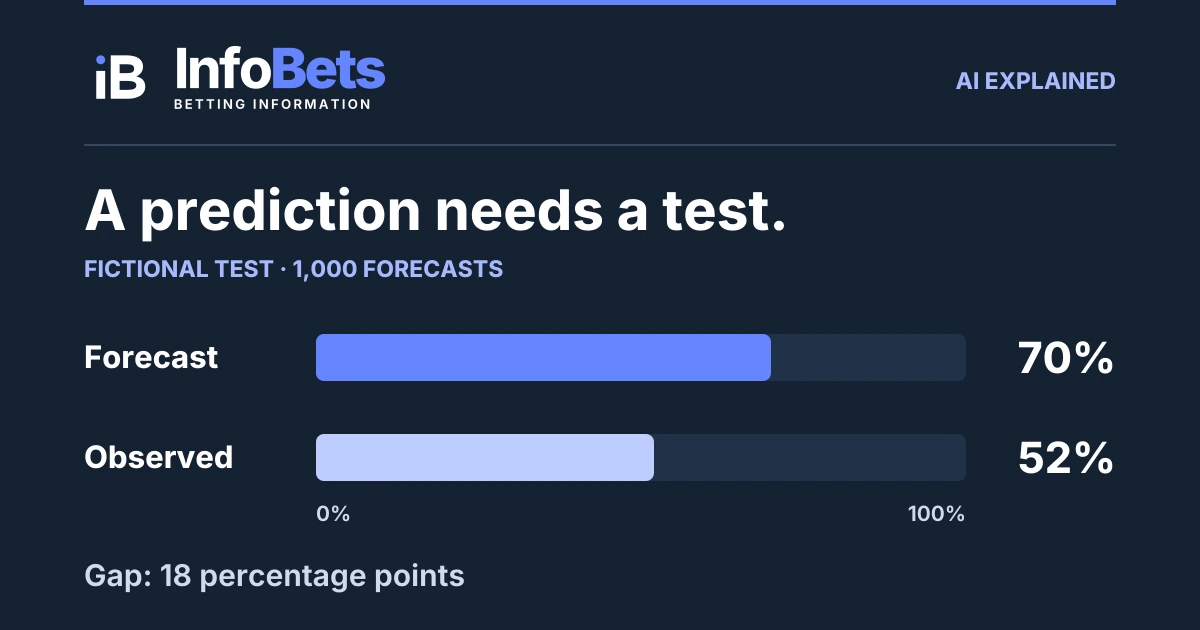
Here is a fictional test: a model records 1,000 forecasts at 70% before their events. The predicted outcome occurs 520 times. The observed rate is 520 ÷ 1,000 = 52%, which is 18 percentage points below the forecast.
That gap gives you a reason to question the probabilities. The sample, test design & uncertainty still matter; one summary does not establish how every future prediction will behave.
Check the test, not just the headline score
- Was the prediction saved before the event? A reconstructed forecast can accidentally use information that arrived later.
- Was evaluation data kept separate? Testing on information used to train or tune the model can make performance look better than it is.
- Does the test match the claim? Evidence about one sport, market or time period does not automatically establish performance elsewhere.
Using information that would be unavailable when making the prediction is called data leakage. The scikit-learn documentation explains why it can inflate reported results.
Is 70% the same as the bookmaker’s probability?
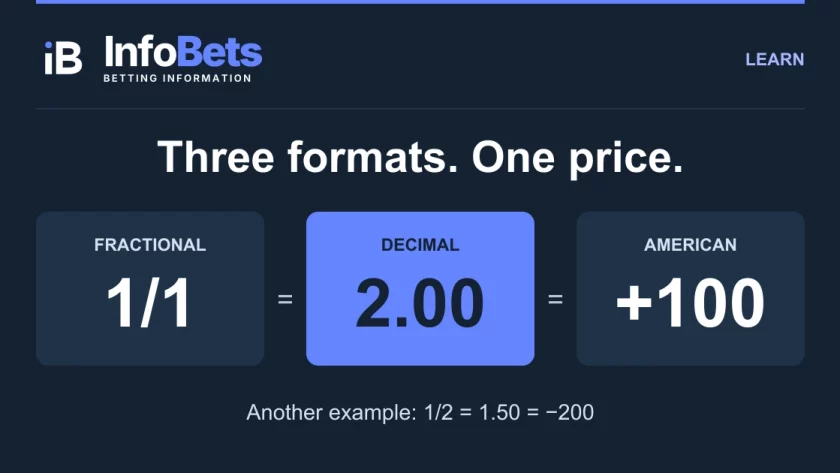
Not necessarily. Decimal odds of 2.00 imply 1 ÷ 2.00 = 50% from the price. A model’s 70% is a separate estimate. Neither number alone establishes the true chance, & disagreement does not establish a profitable bet.
Before relying on an AI percentage, look for its source, timestamp & published testing method. If those are missing, you cannot assess the claim from the number alone. Information only. 18+.
Sources
- scikit-learn: probability calibration
- scikit-learn: data leakage
- NIST: generative AI errors & evaluation
- Smarkets: odds-implied probability
Sources checked 7 September 2026. Any numerical examples are illustrative.

Discussion
Ask a question, add useful context or share a source. Keep it relevant & respectful.
Comments are reviewed before publication.