
The Ultimate Guide to Padel Betting
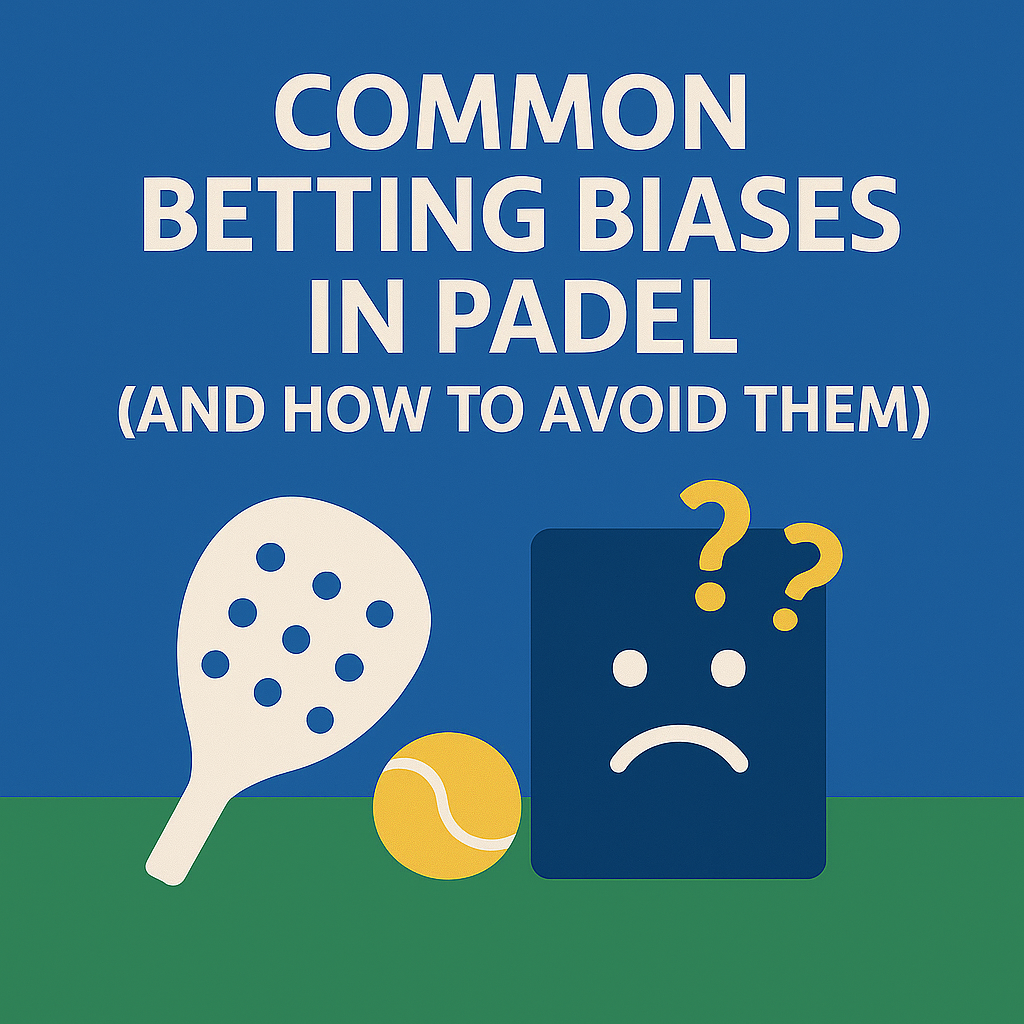
Betting biases are psychological traps that cause bettors to make emotional, irrational, or statistically poor decisions. Padel — with its rapid momentum swings, unpredictable rallies & partnership dynamics — is especially vulnerable to these biases.
This guide breaks down the most common padel betting biases, how they affect your decisions & the practical steps to avoid them.
What Are Betting Biases?
Betting biases are mental shortcuts that lead to incorrect judgments.
In padel betting, they cause:
❌ Overconfidence
❌ Misjudging form
❌ Ignoring conditions
❌ Overreacting to recent results
Understanding these biases helps you make clear, structured decisions.
1. Recency Bias (Most Common)
Recency bias is when bettors overvalue the last 1–2 matches & ignore long-term performance.
Example:
Team A lost yesterday → bettors avoid them
Team B won yesterday → bettors overrate them
But padel form is measured over 5–10 matches, not one.
How to Avoid:
✔ Check last 10 matches
✔ Consider strength of opponents
✔ Compare indoor vs outdoor form
2. Favourite Bias
Bettors often overestimate the probability that a well-known pair will win.
Why it happens:
- Familiar names feel safer
- Rankings influence perception
- Bookmakers shade odds toward favourites
How to Avoid:
✔ Look at form trends, not reputation
✔ Check tactical matchups
✔ Evaluate court speed suitability
3. Underdog Bias
Some bettors lean too heavily toward underdogs because they “feel like value.”
Problem:
High odds ≠ value.
Avoid by:
✔ Calculating true probability
✔ Avoiding emotional choices
✔ Betting underdogs only when conditions favour them
4. Outcome Bias
Outcome bias is judging a bet based on the result, not the decision quality.
Example:
- Smart bet loses → bettor thinks it was “bad.”
- Poor bet wins → bettor thinks they’re “good.”
How to Avoid:
✔ Review decision process, not outcome
✔ Track expected value (EV)
✔ Log pre-match reasoning
5. Momentum Illusion Bias
Many bettors misread momentum, thinking:
“They won the last 2 games—they must win the match!”
But padel momentum swings frequently.
How to Avoid:
✔ Look for sustainable momentum (net control, long rallies won)
✔ Not short-term runs or random variance
6. Narrative Bias
Bettors love stories:
“This team is on a revenge mission.”
“They always win on centre court.”
None of this is statistically reliable.
Avoid by:
✔ Ignoring commentary narratives
✔ Using data-driven reasoning
7. Overconfidence Bias
Winning streak → bettors increase stake size.
But overconfidence leads to:
❌ poor bankroll discipline
❌ ignoring risk
❌ chasing big odds
Avoid by:
✔ Maintaining fixed unit size
✔ Keeping emotional distance
✔ Setting strict daily limits
8. Anchoring Bias
This occurs when bettors rely too heavily on one piece of information.
Examples:
- Ranking differences
- One recent head-to-head
- A single big win
Avoid by:
✔ Considering all factors: form, surface, tactics, weather
✔ Not overvaluing one statistic
9. Confirmation Bias
Bettors selectively look for information that supports their opinion.
Example:
You think Team A will win → you only notice:
✔ Their good form
❌ but ignore weaknesses
Avoid by:
✔ Forcing yourself to argue the opposite side
✔ Checking objective stats
10. Emotional Bias
People bet based on:
- Favourite players
- Favourite teams
- Players they follow on social media
This clouds judgment.
Avoid by:
✔ Never betting on or against players you “love” or “hate”
✔ Sticking to structured evaluation systems
How to Build a Bias-Free Betting Process
Use this 6-step method:
✔ Step 1: Analyse form (last 10 matches)
✔ Step 2: Identify tactical matchups
✔ Step 3: Evaluate court speed
✔ Step 4: Check weather (outdoors)
✔ Step 5: Examine partnership chemistry
✔ Step 6: Compare your estimate vs bookmaker odds
If these steps disagree with your intuition → trust the process.
Quick Anti-Bias Checklist
Before placing a bet, ask:
✔ Am I relying on reputation?
✔ Am I overvaluing recent results?
✔ Am I ignoring conditions?
✔ Am I betting emotionally?
✔ Do I have real value or just “hope”?
If any answer is “yes,” stop & reassess.
Summary
Betting biases lead to poor decisions, inconsistent results & long-term losses.
By understanding & avoiding:
- Recency bias
- Favourite/underdog bias
- Momentum illusions
- Outcome bias
- Emotional betting
you become a more disciplined, data-driven bettor.