
AI citations: a source link is not a fact check

Share this article
Select & copy this link with your device’s copy command.
An AI answer can contain a convincing source link yet still make an unsupported claim. The link is a starting point for checking the answer. Its presence is not proof that the answer matches the source.
This matters when AI summarises an iGaming policy, explains a technical product or describes a company. A small invented detail can change what a reader believes.
What an AI hallucination looks like
Generative AI can produce confident statements that are false, including invented reasoning or citations. NIST calls this “confabulation”, also commonly called hallucination. Its Generative AI Profile specifically recommends reviewing sources & citations during testing & ongoing monitoring.
Connecting an answer to retrieved material is often called grounding. That can make the answer easier to inspect, but an inaccurate source can still produce a grounded yet incorrect answer. Google’s machine-learning glossary makes this distinction.
One sentence, three claims
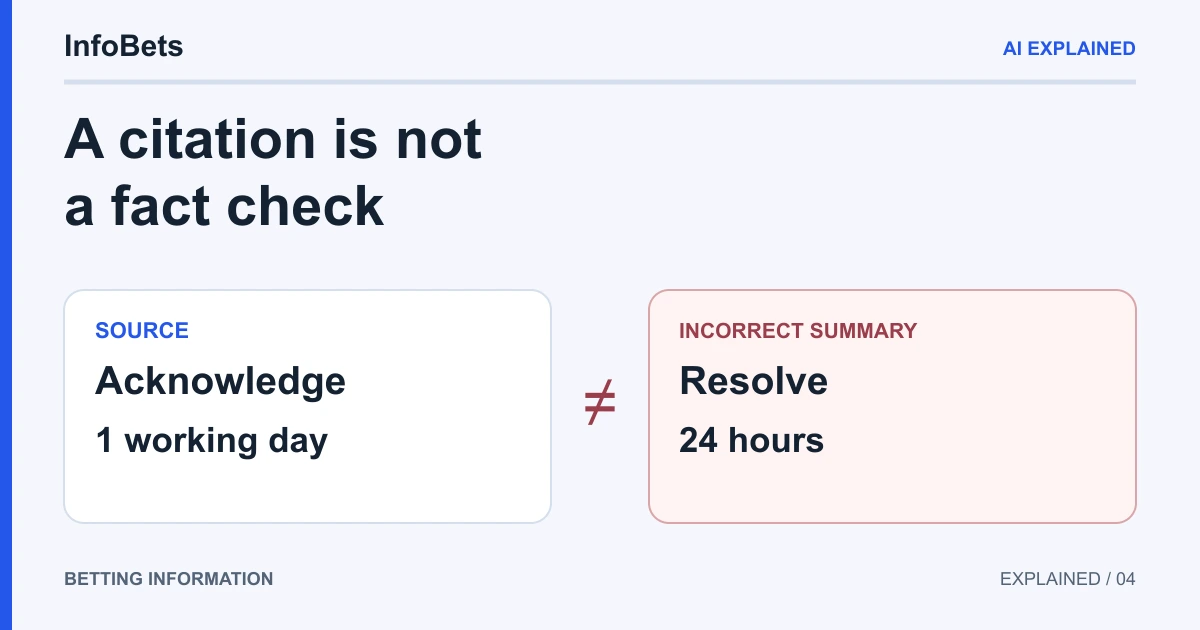
Consider a fictional summary: “Atlas Support resolves every complaint within 24 hours, in all countries, at no charge.”
The linked document actually says: “We aim to acknowledge support requests within one working day.” Neither organisation nor policy in this example is real.
The summary has turned an acknowledgement target into a resolution guarantee. It also added worldwide coverage & a price claim. Even if the link opens correctly, it supports none of those additions.
A faithful summary would keep the limited meaning: the stated target concerns acknowledgement, measured in working days. It would not fill gaps with assumptions about resolution, geography or cost.
Check the claim, rather than the appearance
- Open the source. Confirm that the document exists at the stated publisher’s site.
- Find the supporting passage. A source about the same broad topic may not support this sentence.
- Compare scope. Look for conditions, dates, markets, product versions & exceptions.
- Separate evidence from inference. If the answer draws a conclusion, label it as a conclusion instead of presenting it as the source’s wording.
Keep uncertainty visible
If a document does not answer a question, the useful response is to identify the missing information. Asking the AI to sound more certain does not supply that information.
For a published explainer, record the source, access date & passage supporting each consequential claim. Someone else should be able to repeat the check without trusting the writing style.
A clear answer preserves the difference between what the source says, what the writer concludes & what remains unknown. That makes it easier to correct when the underlying document changes.
Sources checked 14 September 2026. The support-policy example is fictional.
Discussion
Ask a question, add useful context or share a source. Keep it relevant & respectful.
Comments are reviewed before publication.